LCG CONTINUES MULTI-AGENCY EFFORTS TO ADDRESS HOMELESSNESS IN LAFAYETTE

LCG CONTINUES MULTI-AGENCY EFFORTS TO ADDRESS HOMELESSNESS IN LAFAYETTE
LAFAYETTE, LA – Lafayette Consolidated Government (LCG) announced ongoing initiatives and partnerships aimed at addressing the growing challenges associated with homelessness in Lafayette, emphasizing that the issue requires compassionate, coordinated, and long-term solutions.
“Homelessness is a complex issue that affects not only those experiencing housing insecurity, but also the quality of life and safety of our entire community,” said Christina Dayries, Chief of Staff with Lafayette Consolidated Government. “There is no single solution. Addressing these challenges requires collaboration among government, nonprofit organizations, healthcare providers, law enforcement, emergency responders, and the community as a whole.”
Lafayette currently has approximately 103 emergency shelter beds and approximately 36 transitional shelter beds available, while an estimated 400 individuals are experiencing homelessness, of that 205 are unsheltered. According to local service providers, the shortage of emergency, transitional, permanent supportive housing, and deeply affordable housing remains the greatest obstacle to moving individuals from homelessness to long-term stability.
Lafayette Consolidated Government continues working alongside nonprofit organizations, law enforcement, emergency medical services, healthcare providers, and community stakeholders to expand resources and create multiple pathways to address homelessness while responding to the concerns of residents and businesses.
Among the efforts currently underway are:
-
- Strengthening public spaces: Lafayette Transit System has begun installing “No Trespassing and No Loitering” signs at bus stops throughout the city. These signs provide law enforcement with the authority to require individuals using bus stops as shelters to leave the area and issue a summons when necessary.
- Litter cleanup operations: LCG transit crews have initiated routine cleanup efforts to remove trash and debris from public spaces.
- Continued outreach and engagement: Local nonprofit organizations respond to complaints involving individuals experiencing homelessness and offer available services and assistance. However, many individuals decline available resources.
- Enhancing downtown safety and cleanliness: Catholic Charities of Acadiana recently partnered with the Lafayette Police Department to provide additional security and enforcement operations. The organization has also contracted with the Block by Block Ambassador Program to provide litter removal and cleanup services. Both initiatives cover the 15-block area surrounding the Catholic Charities shelter and dining facility.
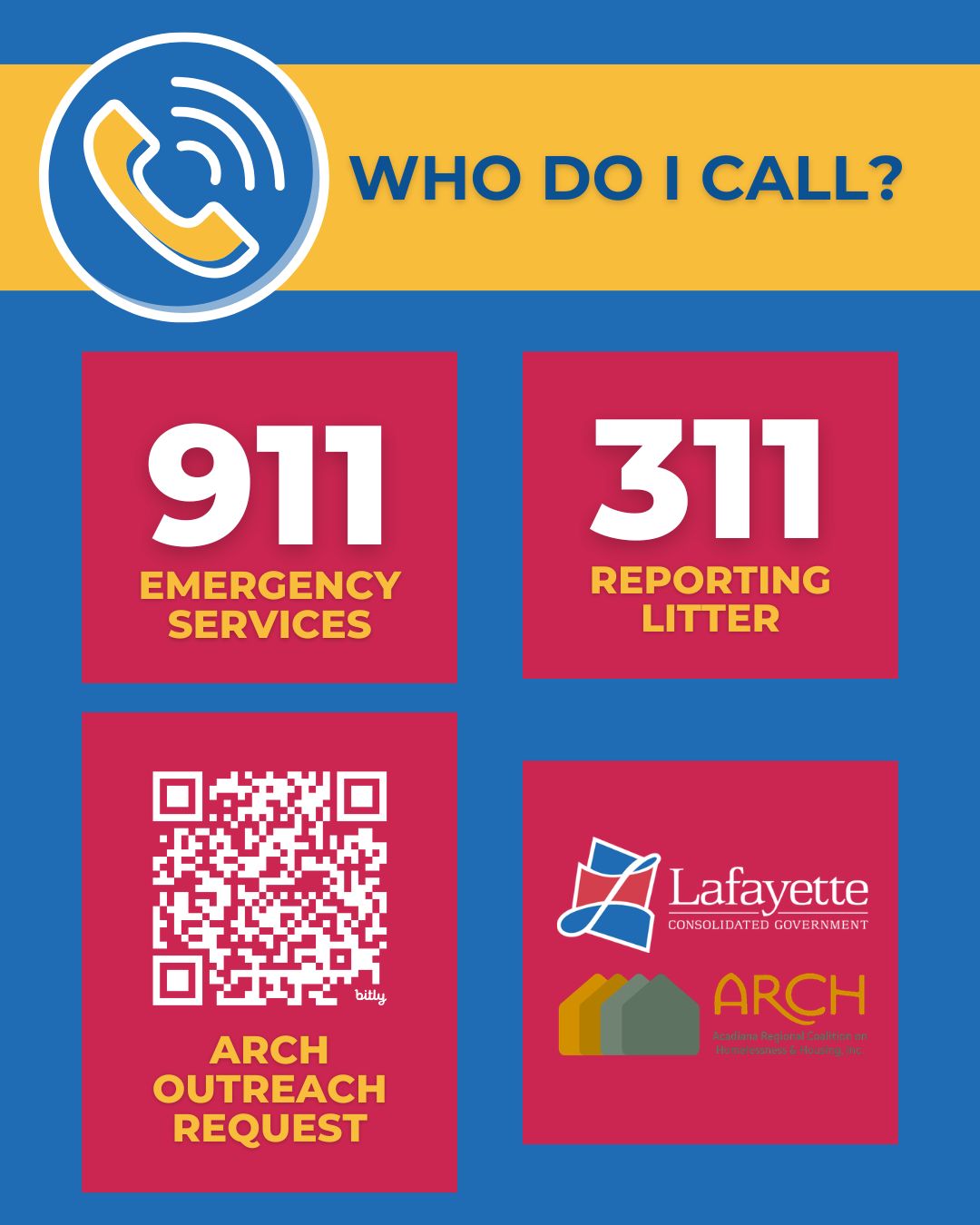
- Community reporting tool: The Acadiana Regional Coalition on Homelessness (ARCH) recently launched an online reporting system that allows residents to request non-emergency outreach support for individuals experiencing homelessness at bus stops, encampments, and other locations. Residents should continue to call 911 for emergencies.
- Focused case management through the 12 Together Coalition: A coalition of nonprofit organizations, law enforcement, EMS, healthcare providers, and government agencies has been formed to provide intensive case management and permanent supportive housing solutions for the twelve highest-utilizing individuals experiencing homelessness in Lafayette. Several individuals have already been successfully housed, and work continues with others.
- Expanding transitional housing opportunities: Lafayette officials are engaged in discussions with The Refinery, a successful recovery and transitional housing program based in St. Landry Parish, regarding the possibility of expanding its model into Lafayette. The program emphasizes sobriety, life-skills development, employment, and successful reintegration into the community.
- Investing in housing and homeless services: Since taking office, the Boulet Administration has awarded more than $2 million in Community Development grant funding to support housing initiatives and homeless service programs.
- Addressing behavioral health needs: Recognizing the connection between homelessness, mental illness, and substance use disorders, the administration has committed $1.9 million in opioid abatement funding toward the development of a Crisis Center designed to provide behavioral health services and intervention.
- Strengthening recovery through Drug Court: The administration has also allocated opioid abatement funding to expand services within the Lafayette Drug Court program. During the recent reporting period, grant-funded services supported 304 participants through housing assistance and electronic monitoring, improving treatment engagement, enhancing accountability, and reducing recidivism.
“Many of the individuals we encounter struggle with mental illness, addiction, or chronic health issues,” said Dayries. “Meaningful progress requires sustained partnerships, continued investment in housing and behavioral health resources, and a balanced approach that combines compassion with accountability and enforcement. We remain committed to pursuing solutions that help individuals regain stability while protecting the quality of life and safety of our community.”
###